How to Raise a Lean Startup – III

Lean Startup

<< Part II

I practice Scrum / XP in the software projects I manage. As part of the same, the team iterates over sprints during the development of the project. The sprints are kept as short as possible (usually a week long) so that feedback loop is short. At the end of each sprint, the team gets feedback on whether they built the right product or not. Likewise, for a ship cruising on the ocean, frequent checks of the current route vis-a-vis the planned route are preferred so that course corrections (if any) are short.

Ries illustrates the same spirit of short feedback loops in the diagram below:

Feedback Loop

The aim is to quickly show something to the customer so as to seek his acceptance and then move onto the next iteration to add some more features or perhaps remove some existing feature based on the feedback received. Ries puts it eloquently, “…the goal of the MVP is to begin the process of learning, not end it. Unlike a prototype or concept test, an MVP is designed not just to answer product design or technical questions. Its goal is to test fundamental business hypotheses“.

While the entrepreneur is incorporating feedback and working to improve the product, how does he ensure that he is on the right track. This is where innovation accounting comes into play. It comprises of prioritising product features, selecting a target market, and critiquing the vision in the light of market feedback. Innovation accounting has the following steps:

  1. Using an MVP to have a firm grasp on the current position of the startup
  2. Trying to move this baseline to where the startup would like to be by tuning it up
  3. Finally, arriving at a decision on whether to pivot or persevere

The entrepreneur should be careful in measuring the data lest he finds himself obtaining vanity metrics (that wrongfully depict the startup to be in a healthy or improving condition) instead of real metrics.

The above help the entrepreneur in deciding whether to pivot or persevere. While persevering is relatively easy to understand – iterating through the build-measure-feedback loop continuously while tuning the product continuously – pivoting requires a little explanation. Pivoting doesn’t mean throwing away everything and starting from scratch. It is about reusing whatever has been built to the extent possible and then building on top of it to target customers afresh. Pivots can be of one of the following types:

Zoom-in Pivot: what was earlier only a feature of the product becomes the product now and other features are either abandoned or assume lesser significance.

Zoom-out Pivot: the product itself is insufficient and thus more features are added to it to create a new product.

Customer Segment Pivot: the product solves a real customer problem but it would better serve a different customer segment than the one it is currently targeting.

Customer Need Pivot: the need being solved currently is insignificant as compared to the one that can be solved without repositioning too much.

Platform Pivot: this is a pivot from selling a product that solves a particular need to let customers use it as a platform for provide similar services.

Business Architecture Pivot: this is a pivot between high margin, low volume business (usually B2B) and low margin, high volume business (usually consumer products).

Value Capture Pivot: a different feature can be monetised instead of the one currently being so.

Engine of Growth Pivot: the company can pivot among the engines of growth – viral, sticky, and paid. This usually requires a pivot in capturing value as well.

Channel Pivot: a pivot in the distribution channel of the product / service.

Technology Pivot: the company can pivot on the technology that provides a better cost advantage or better performance
Continue to Part IV >>

How to Raise a Lean Startup – II

Lean Startup

<< Part I

Learning is the centrepiece of Lean Startup. So much so that the the progress of a Lean Startup is defined in terms of learning milestones and people are held accountable to the same rather than organising them in traditional departments and holding them accountable to individual responsibilities.

The real motive of an MVP is to generate learning. This is because more important than building something efficiently is building the right thing. No point building a great product with a greater process that no one desires. Thus learning helps in validating the hypotheses the entrepreneur makes when building his product.

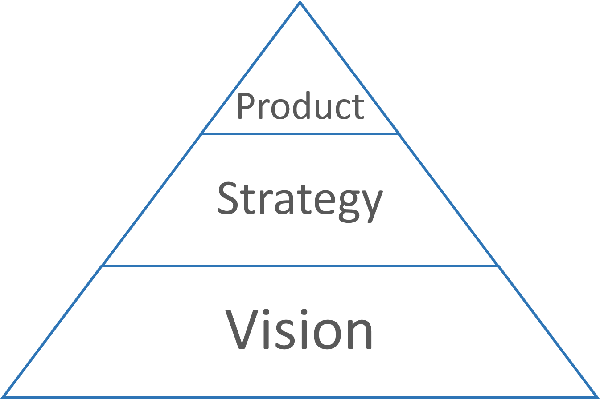
This product is refined based on the feedback generated from the market through the use of MVP. In the face of this feedback, which might not always be positive, the entrepreneur, might have to decide whether to continue to work on the same product or choose a different strategy. But such decisions are less frequent than the tuning done to the product. Even less frequent, if at all, are changes to the overarching vision with which they set out to become an entrepreneur.

Pyramid

As Ries says, “…a startup is a portfolio of activities. A lot is happening simultaneously: the engine is running, acquiring new customers and serving existing ones; we are tuning, trying to improve our product, marketing, and operations; and we are steering, deciding if and when to pivot. The challenge of entrepreneurship is to balance all these activities.

Not just startups but even existing organisations need to learn and innovate continuously in order to maintain their competitive edge or gain one. In this ever changing technological landscape, such edges get eroded very fast. Consider Blackberry that had long enjoyed the image of a premium, enterprise mobile handset company. It had two major advantages over its competitors: push mail service and Blackberry Messenger. With the rise of smartphones and their numerous apps, both these advantages were laid to waste. The result, Blackberry’s share in the market, which has already reduced to a minimum, is shrinking rapidly. The company is desperately looking for someone to buy it out but nobody wants to.

There is a trap in trying to learn what customers want. An entrepreneur should be able to distinguish between what the customer is asking for and what he really wants. This is because a lot of times customers don’t know for sure what they want. Identifying the real wants and working on the same causes the startup to grow and evolve. This is what Ries calls Validated Learning.

The question is not “Can this product be built?” In the modern economy, almost any product that can be imagined can be built. The more pertinent questions are “Should this product be built?” and “Can we build a sustainable business around this set of products and services?” – Ries

Mark Cook, Vice President of Kodak Gallery says the same thing in his own words:

  1. “Do consumers recognize that they have the problem you are trying to solve?”
  2. “If there was a solution, would they buy it?”
  3. “Would they buy it from us?”
  4. “Can we build a solution for that problem?”

All the above is based on the cornerstone of experiments. I had read somewhere (I think it was Stephen Hawking’s “A Brief History of Time”) that an experiment cannot be considered a failure if it disproves your hypothesis. It’s a failure when it is inconclusive. Therefore even if the product fails, the experiment is still a success because we know what the customer doesn’t want.

Now, how to structure the experiment, the hypothesis. Ries considers two hypotheses to be structured: value hypothesis and growth hypothesis.

Value Hypothesis tests whether the product / service being built would actually deliver value to the customer. This hypothesis helps in answering the question would there be customers (early adopters) who would buy the initial versions of the product (MVP) and find it useful.

Growth Hypothesis tests whether the product’s purchase and usage would spread from early adopters to the masses. This helps in answering the question would the business grow from the initial success with early adopters.

Continue to Part III >>

How to Raise a Lean Startup – I

Lean Startup

Most of you would be aware of the term “Lean”, thanks to its overuse by a lot of organisations these days (and some slimming centres too). Startup, again, is not an unfamiliar term as every new tech company calls itself a startup.

However, what you might be wondering is “what is a lean startup”. It isn’t a startup with very few employees (as almost all of them already are). It is a startup that has been founded on the principles of Lean and following an MVP (Minimum Viable Product) based approach to starting-up.

Wikipedia describes MVP as “a strategy used for fast and quantitative market testing of a product or product feature“. Also mentioned alongside is the name of Eric Ries. For those familiar with startup landscape, Ries is a celebrity. He is said to have popularised the term MVP. Some attribute the term entirely to him.

Ries has a very popular blog on Lean Startup and a site that serves as a selling platform for his bestselling book “The Lean Startup” (which doesn’t need selling though). His blog has a very interesting quote from his book:

Startup success can be engineered by following the process, which means it can be learned, which means it can be taught.

Now this is in stark contrast what some of us might think or have even experienced. Startup success has been considered enigmatic, even elusive like a mirage. But here is Ries claiming that there is a definite process to it. This gives the impression that it can be synthesised as if in a Chemistry lab or manufactured as if on an assembly line.

But what gives him that confidence to make such a bold statement. He attributes it to the concept of MVP or in his words, “the build-measure-learn” feedback loop. Through this loop, the entrepreneur builds a bare minimum product in order to test his assumptions / hypotheses, measures the reactions of customers thus validating / invalidating the hyotheses, and generates learnings in the process.

Ries outlines 5 principles of a lean startup:

1. Entrepreneurs are Everywhere
Ries considers anyone who fits the following definition as an entrepreneur: “a human institution designed to create new products and services under conditions of extreme uncertainty”. A person doesn’t necessarily have to work out of a garage to be one.

2. Entrepreneurship is Management
Even a startup requires management, in fact, more than traditional organisations because a startup might have bigger and frequent challenges. However, traditional management is not of much help here and one needs to think out of the box that various business schools have created.

3. Validated Learning
Ries defines this as the single most important measure of progress in a startup. The startup iterates through multiple failures to arrive at success and, in the process, gains invaluable lessons that help it in the next iteration. This learning is validated by its customers who either accept or reject its products / services.

4. Innovation Accounting
As boring as accounting may be, its importance for startups cannot be overstated. Measuring progress, defining and tracking result metrics, setting up milestones are all tasks that an entrepreneur needs to fulfil zealously.

5. Build-Measure-Learn
Startups must continuously churn out products, measure their acceptance with the customers, and incorporate their feedback so as to either turn their strategy on a sixpence (pivot) or continue to push harder (persevere).

Continue to Part II >>