
I have moved around a fair bit in my career spanning almost 15 years. But it has definitely helped me build an extensive experience over the years with organisations ranging from 10 people startups to enterprises like Telstra to global behemoths like Oracle, in industries from Financial to Sports-tech to Telecommunications to Utilities, in roles from permanent staff to consultant to independent contractor. It has helped me develop a perspective on how the ways of working differ from organisation to organisation even when they are similar sized or in the same industry and how I can add value to them. Over the years, I have developed a significant expertise in Agile Coaching and Leadership (depth of my T-shaped skills) and adeptness with other areas like Software Development, Delivery Management, Project Management, Business Analysis, Testing, etc. (width of the T). I leverage my experience to enrich my work and my interactions with my colleagues. And this experience has been worth its weight in gold for me.
Every time, I have decided to move on from a job either voluntarily or because my contract was coming to an end, I have evaluated my options and tried to make the best choice. In the initial years of my career, that choice was more of a heuristics based decision. However, in the last couple of years, I have formulated a set of criteria that helps me make this decision better. I evaluate each potential employer with respect to the following 3 criteria:
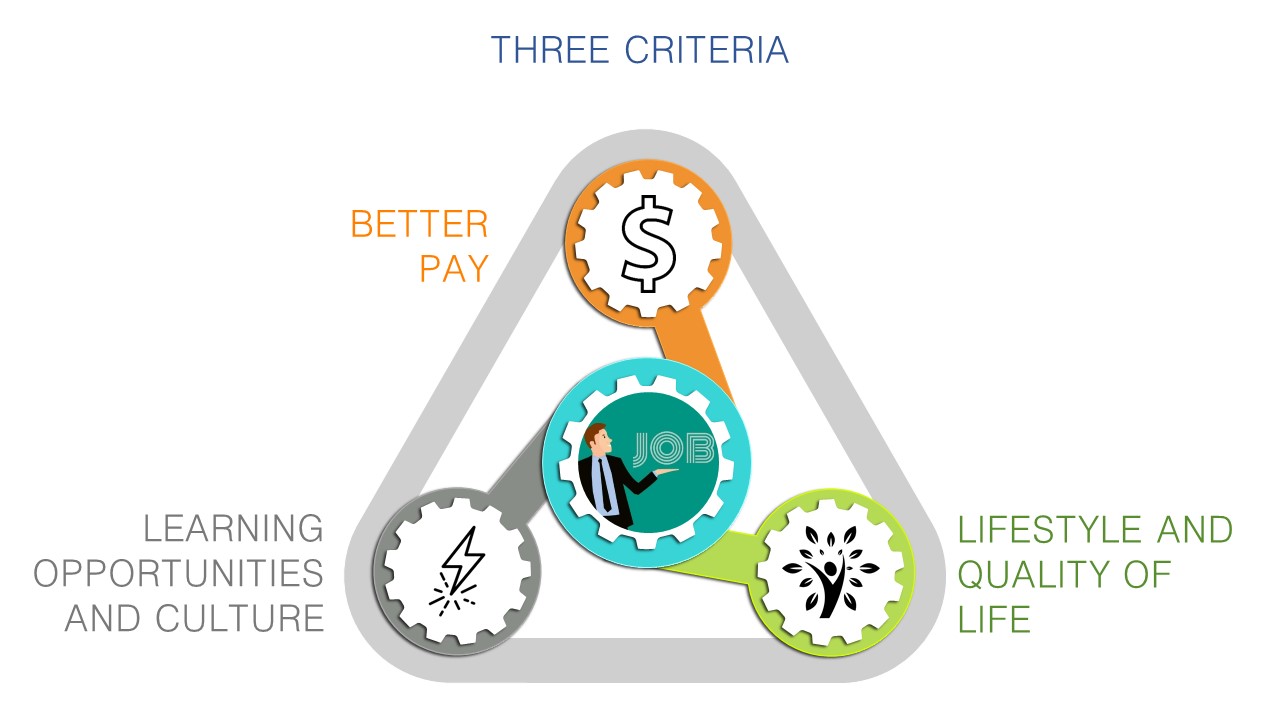
1. Better Pay
Do I earn more than my current pay? Day rate contract jobs always pay better than fixed term ones or permanent jobs but do I want to take short term contract job just for better pay and then be back in the market again?
2. Learning Opportunities and Culture
Are there any training opportunities (more common with fixed term or permanent jobs)? Or do I stand to learn new things by working with experts or people in a new area? Is the culture one that fosters growth, creativity, and independent thought? Is it okay to fail (a culture that enables psychological safety)? Is it fun to work there? Sometimes you get hints about these from people in your circle who have worked there. Other times you just have to take a leap a faith and experience it for yourself.
3. My Lifestyle and Quality of Life
I go to the gym 3 times a week (nowhere near looking like Arnold Schwarzenegger or Rock), Buddhist meditation 2 times a week (even further from being enlightened), meetups on Agile and related things, and catch up with friends frequently. Would I like to do a job that compromises one or more of these things? Can I work it out by going to the gym or meditation classes at different times or at different places?
While the above things might seem random or even vain (money, lifestyle etc.), there is a method to this madness. Underpinning the above are 3 main values:

1. Mental Health
2. Financial Health
3. Physical Health
While I have made a conscious decision in the past to move to job that pays a bit less (when moving from a day rate contract to a fixed term one), I have made sure that I am not jeopardising my financial health. I will take up a job that is challenging over one that is boring. I will take up one where I have more avenues to stay fit and engage in social activities than one where I have to work long hours even though I am being paid way more. At the end, it is like technical debt. I might choose a job where I am less better off on one of the above factors but at some point, the debt needs to be paid off. And the question I ask myself is, “Is it worth the debt?”.
I might also add that, in the past, I have actually chosen to not go for organisations that are responsible (directly or indirectly) for destroying people’s lives (gambling, tobacco, cigarettes, etc.) or the environment (energy companies heavily invested in coal and fossil fuels).

 Rajat Bhalla