Blog

Buying an SUV

I have always dreamt of owning an SUV, one of those big bad automobiles that seem so invincible. Because dreams don’t have price or other constraints built in, I had my heart set on Hummer. As reality dawned upon me over the years, I realised that I would have to settle for something more practical (and less expensive).

The desire for Hummer was gradually replaced by that for Honda CR-V, a powerful and sporty SUV. However, it lost its appeal over the past couple of design changes and the more compact it grew, the less I liked it. In the meanwhile, I had begun to take a strong liking for Ford Endeavour. The very name made my heart skip a beat. It was simply huge. It actually defined the term SUV for me. Big and powerful.

So when I finally had the purchasing power to buy a car (an SUV to be specific), Endeavour was my first priority. But, because, a lot many SUVs had arrived on the scene by now, I actually had a long list of candidates. The following is a list of models I started with.

Brand Model Verdict Notes Price – Low (Lakhs) Price – High (Lakhs)
Mahindra Thar Pending Too brash 5 6
Tata Safari Pending Too common 8 13
Mahindra XUV 500 Pending Too common 12 14
Skoda Yeti Pending 14 18
Ford Endeavour Pending Too large 15 20
Suzuki Grand Vitara Pending 17 19
Chevrolet Captiva Pending Small 19 25
Mitsubishi Outlander Pending 21 21
Toyota Fortuner Pending 21 22
Mitsubishi Pajero Pending 21 25
Hyundai Santa Fe Pending 22 25
Ford Escape Pending Awaiting launch
Mahindra Bolero No No visual appeal 6 7
Mahindra Xylo No Not a SUV 7 10
Renault Duster No Small 7 11
Mahindra Scorpio No No visual appeal 8 13
Force One No Not impressive 11 11
Mahindra Rexton No No visual appeal 20 20
BMW X1 No Small 22 30
Nissan X-Trail No Not impressive 23 27
Mitsubishi Montero No Too expensive 41 41
Toyota Land Cruiser Prado No Too expensive 60 60
Toyota Land Cruiser No Too expensive 98 98
Land Rover No All expensive models

However, I eliminated almost half of the models (the ones with Verdict as “No”) on the list based on preliminary research.

You might ask why did I put those models on the list in the first place. To answer simply, I didn’t want to look back and think that I left out a model that could have been a good candidate for purchase. Also, I wanted to know for sure that the model I would choose would be better than the others (at least, in my view). 🙂

So what are the key factors that I would be basing my decision on? I would list them as under (not necessarily in the order of importance)

  • Powerful
  • Tall body / high seating
  • Muscular looks
  • Ample leg room

Once I had the complete list and a set of parameters to rank them on, I decided to take the plunge and started requesting test-drives.

Here’s how it went… but before that a disclaimer:

Please note that the findings below are not based on scientific / statistical information. They are purely my personal experiences and do not attempt to define the vehicle in any way.

Toyota Fortuner

Toyota Fortuner

Image source: http://www.toyotafortuner.in

Date of test-drive: 30 Sep 2012

Dealer: Galaxy Toyota

Model driven: 4 x 4 MT

Model preferred (from purchasing perspective): 4 x 2 MT

On road price: Rs 25 lakhs (approx.)

Engine: 3 litre (approx.)

Chassis: Monocoque

Test-drive Results

Fortuner Performance

Details:

Smooth drive despite a potholed road. Perhaps this comes from a good suspension and monocoque body.

Easy manoeuvrability. I was able to turn with a small radius and the power steering greatly helped.

The beast was found wanting in leg room though. When I sat comfortably in front, the passenger behind me was not left with too much space.

Interiors:

The dealer did not have a 4×2 MT to show so I could only superimpose the salesman’s words onto the interiors of 4×2 MT.

The sales person wasn’t very knowledgeable on what features are available in what model of the car. He actually told me that the base 4×2 MT version had SatNav while it doesn’t! Thankfully another sales guy joined us who knew a lot more and could project an honest picture of the car.

Verdict:

Despite the price being on the higher side and the car doing just OK on leg room, a major factor for me, I would still consider it a strong contender.

Ford Endeavour

Ford Endeavour

Image source: http://www.india.ford.com/suvs/endeavour

Date of test-drive: 30 Sep 2012

Dealer: Harpreet Ford

Model driven: 4 x 2 MT

Model preferred (from purchasing perspective): 4 x 2 MT

On road price: Rs 21 lakhs (approx.)

Engine: 3 litre (approx.)

Chassis: Ladder-frame

Test-drive Results

Endeavour Performance

Details:

The ride wasn’t very smooth. I could feel the jerkiness of the vehicle. This could have been because of the ladder-frame chassis. The gear shift was hard and the brake pedal made a noise when pushed. There was no rear camera or even a parking mirror for backing up / parking.

Interiors:

There were no controls on the steering wheel. The control panel extending from the dashboard to the gear level was sadly basic.

However, all’s not doom and gloom with the Endeavour. One aspect where it beats all the other SUVs is leg room. The leg room was more than enough for a giant.

Verdict:

Despite the performance being so-so, I would still consider it in the list of contenders but it is way down in the list.

UPDATE:

Because I had loved the Endeavour since long, I wasn’t going to write it off so easily. So I took another test-drive of it. The car shook when I drove it over the potholes and I could hear lot of thumping and banging from the rear end of the SUV. (No, it’s not what you might be thinking). Owing to the long tail of the car and ladder-frame chassis, the rear end bounced like crazy. Had there been any passengers sitting there, they would have experienced a roller coaster of sorts.

So here’s my final verdict on the Ford Endeavour: No 😦

UPDATE:

Mahindra XUV 500

Mahindra XUV 500

Image source: http://www.mahindraxuv500.com

Date of test-drive: 1 Oct 2012

Dealer: Sri Durga Automobiles

Model driven: 4 x 2 MT

Model preferred (from purchasing perspective): 4 x 2 MT

On road price: Rs 14.2 lakhs (approx.)

Engine: 2.2 litre (approx.)

Chassis: Monocoque

Test-drive Results

XUV500 Performance
Details:

The ride was surprisingly smooth owing to the monocoque chassis perhaps. Gear shift was easy and the car responded well to accelerator. Easily manoeuvrable. The 4×2 MT model doesn’t come with alloy wheels. And there is one point about the XUV500 that I must mention.

Its overly done.

It is a good car at a good price but, from its looks, it appears as if all the designers woke up one day and decided to add all their design ideas to the same car. The car could have done with less fanciness.

Interiors:

The plastic used in the interiors is not of great quality. There is no rear camera or a parking mirror. Basic interior in general.

Verdict:

A strong contender especially given the performance and the price. Don’t be surprised if it emerges as the final choice.

Tata Safari

Tata Safari

Image source: http://www.tatasafari.com

Date of test-drive: 1 Oct 2012

Dealer: Malwa Automobiles

Model driven: VX Dicor 4 x 2 (Manual)

Model preferred (from purchasing perspective): Not sure owing to multiple models going out of production and an expected launch of Tata Safari Storm

On road price: Rs 10 – 11.5 lakhs (approx.)

Engine: 2.2 litre (approx.)

Chassis: Ladder-frame

Test-drive Results

Safari Performance

Details:

The ride was ok. Response to acceleration was ok too. Manoeuvrability is wanting. Turning radius is large. Either my foot or the clutch pedal stuck more than once. Lacks important features like airbags.

It was the first SUV in India but it doesn’t seem to have improved much since its first launch. It is the general public opinion that Tata vehicles are similar to commercial trucks that ferry goods. After driving the Safari, I knew why they think so.

The above notion about Tata’s vehicles perhaps carries through to their dealerships as well. The salesperson was rustic in his approach, wasn’t very knowledgeable and the dealership was out of brochures for the Safari.

Interiors:

No steering controls. Control panel is very basic. The plastic used in the interiors is not of great quality. There is no rear camera or a parking mirror.

Verdict:

Given the ride performance, the verdict is definitely a No. I would test-drive the Safari Storm too but unless it makes up on where Dicor falters, the verdict stays.

UPDATE:

Hyundai Santa Fe

Santa Fe

Image source: http://www.hyundai.com

Date of test-drive: 5 Oct 2012

Dealer: Hans Hyundai

Model driven: 4 x 2 MT

Model preferred (from purchasing perspective): 4 x 2 MT

On road price: Rs 26.8 lakhs (approx.)

Engine: 2.2 litre (approx.)

Chassis: Ladder-frame

Test-drive Results

Santa Fe Performance

Details:

It was an exhilarating ride. The engine was really responsive to the acceleration and the pick-up was good. No jerkiness in the the ride despite an uneven road. Great manoeuvrability too. The SUV comes with 18″ wheels, the largest among the SUVs test driven till now. The SUV doesn’t look as meek as I had thought. Gear Shift was a little hard or maybe it was the hard clutch pedal.

The dealership didn’t even have a brochure explaining the features of the vehicle. On top of that, the salesperson was not really interested in showing me the vehicle and did so as if he was doing me a favour. Gradually, he warmed upto me but understanding the features that actually come with the vehicle was a little tricky as a lot of custom modifications were done to the SUV.

Interiors:

2-3 controls on the steering. Leg room was less. When I sat comfortably, there was less space behind. From the inside, it doesn’t look too big. They say its a 7 seater but I doubt it unless the ones sitting behind are midgets.

Verdict:

Its a great SUV but given the price, the size of the SUV and that of the engine, I would consider it an over priced SUV. My final verdict on it: No.

UPDATE:

Skoda Yeti

Yeti

Image source: http://www.skoda-auto.co.in

Date of test-drive: 7 Oct 2012

Dealer: Arshia Motors

Model driven: Ambition 4 x 2 MT

Model preferred (from purchasing perspective): Ambition 4 x 2 MT

On road price: Rs 17.6 lakhs (approx.)

Engine: 2.0 litre (approx.)

Chassis: Monocoque

Test-drive Results

Yeti Performance

Details:

I perhaps had a bigger image of Yeti than it turned out to be. They call it a compact SUV but I believe it is no larger (or powerful) than some of the hatchbacks commonly available today. It is too low to be even considered an SUV. Had Skoda projected it as a hatchback, it might have done better. Acceleration was somewhere between OK and good. Ride comfort was good.

Interiors:

The interiors were OK with leather seats even in the basic model. But leg room left a lot to be desired.

Verdict:

Its a great SUV but given the price, the size of the SUV and that of the engine, I would consider it an over priced SUV. My final verdict on it: No.

UPDATE:

Mitsubishi Outlander

Outlander

Image source: http://www.outlander.in

Date of test-drive: 10 Oct 2012

Dealer: Asian Motors

Model driven: P-Line Automatic (Petrol)

Model preferred (from purchasing perspective): I wasn’t expecting Mitsubishi to not have a manual or a diesel based SUV so no model preferred

On road price: Rs 23.5 lakhs (approx.)

Engine: 2.4 litre (approx.)

Chassis: Monocoque

Test-drive Results

Outlander Performance

Details:

There were two shocks that I received in quick succession when the salesperson introduced me to the Outlander. First, it is petrol-only SUV. Second, there is manual variant of it and comes only in automatic. My decision on Outlander was almost made at that moment. However, I still wanted to give it a benefit of doubt. So, I went ahead and test-drove it.

The acceleration was sluggish. This could be because of the automatic transmission as the salesperson told me (I haven’t driven any AT car before so I couldn’t verify his statement). Or this could be specific to the Outlander. Either ways, because it comes only in AT, this is a very real drawback for me.

In manual mode, I could change gears using pedal shift but there was no fun in it as the acceleration still left a lot to be desired.

Interiors:

Seating wasn’t as high as expected but OK. Leg room was good but the steering position was such that I had to push my seat way back lest it would almost rest on my thighs.

The interiors, otherwise, were good and the steering controls were good to have too.

Verdict:

It is a good looking SUV at an OK price but is missing key aspects like diesel and manual variants. My verdict on Outlander: No

Mitsubishi Pajero

As the dealer tells me that the earlier version of Pajero SFX has been discontinued and only Pajero Sport is available which is priced way above my budget. So, this SUV also gets crossed-out 😦

Verdict: No

I would continue to update this blog post as I go about test-driving other models. So stay tuned, my friend…

My Way IS the Highway

Bullet

Ever since man invented the wheel, he has been passionate about it. That passion has manifested in different people in different ways. Some people are head-over-heels with their cars while others swear by their motorbikes.

I haven’t been untouched by this passion. Since childhood, I used to love motorbikes. As I grew older and could discern different models from each other, I realised that my heart lay in Royal Enfield’s Bullet.

My grandfather rode it when he was in the British army, my dad rode it in his youth, and I was adamant to carry the tradition forward.

So I bought myself a top-of-the line Bullet. Bullet Machismo 350. And that’s when I became a Bulleteer.

Unlike the lower models whose thump is too loud and annoying, Machismo’s thump is just right and sounds music to the ears (okay, I may be a little biased here). Listen carefully and you can hear the sound of tappets, the chain rolling, the silencer thumping, all rolled into one smooth melody. Powerful, yet sophisticated.

Its been 5 years since I have been riding her and I have been maintaining her rather well as you can see in this picture. My neighbours see me spending half an hour every morning cleaning and scrubbing it before I leave for work. Once an elderly neighbour finally walked up to me and said, “You take care of it as if it were your son-in-law” (Indian tradition has it that son-in-laws were really respected and cared for). I responded with, “No, I take care of it as if it were my WIFE”!

And my relationship with my Bullet has been like that. We have taken care of each other well and, occasionally, like a real wife, she has hurt me (I have two burn marks on my leg caused by its silencer) and has been burning a hole in my pocket (with rising fuel costs and frequent maintenance)! But, overall, I am quite content with her.

Unlike those who race their plastic toy bikes on the roads to derive pleasure, I simply ride it at an easy speed because the ride IS the pleasure. As I once read on some social network page on Bullet, “You may zip ahead on your toy bike. Your girl still can’t take her eyes off me“. Riding it slowly one feels like a king for whom the peasantry gives way and the commoners turn their heads to get a glimpse of the majestic.

Of late, I converted her to a single-seater as the rear seat has rarely been used in the past 5 years. And a single-seater Bullet looks all the more beautiful.

Given my passion for engines and everything mechanical, I have been trying to tinker with it in order to keep it ship-shape. As a result, I have become friends with a lot of repair shops around as I keep asking them about the Bullet’s internal mechanics.

Most of the roads in New Delhi being chock-a-block with traffic, I relish the early morning ride to Gurudwara every Sunday as I can always enjoy the open roads and the cool weather. Tomorrow being a Sunday, I am already looking forward to the ride. And I am hoping to ride the recently opened highway from New Delhi to Agra soon. If its even close to what is being said about it in news, I am sure I am going to love it.

This blog post won’t be complete without mentioning an incident that happened about two years ago. I was riding along the Upper Ridge road when I realised another rider on my wing. Both of us looked at each other’s ride, admired it, and then gave each other a thumbs up almost synchronously. My ride: Bullet Machismo 350. His, ditto.

Ride on, my friend.

Product Owner 2.0 – Ownership and Beyond

Product Owner 2.0

I had the opportunity to present on this topic recently at a ScrumIndia Conference organised in NCR, India.

As part of my current role of a Project Manager, I have been playing the role of Product Owner for all the projects I have been managing. I started as the vanilla Product Owner that Scrum outlines; continuing to improvise when hit by an obstacle or looking for opportunities to improve. It has been a tremendous learning experience while working with all kinds of clients and teams of different maturity levels on projects of various complexities. My presentation at the conference talked about such practices / beliefs / views.

My experience has primarily been on client projects rather than on internal projects / products. So, to that extent, my perspective might be skewed. But, in my humble opinion, the points I illustrate are independent of the sponsor of the project (external or internal).

So lets start…

Summarising the literature that is available on Agile, one can define the typical role of PO as follows:

  • Responsible for maximizing the value of the work that the Team does
  • Owns the vision and overall goals
  • Owns the prioritized list of what needs to be produced to achieve maximum value and ROI (the Product Backlog)
  • Decides when product is ready to ship

Now, lets see what would separate a PO 2.0 from a PO:

1. PO stands for Proud Owner

Proud Owner

PO doesn’t stand for just Product Owner. It also stands for Proud Owner.

PO 2.0 doesn’t consider a project as just one of the many. He is proud to be a part of it. Like Harley owners who consider themselves privileged to own one (I am a Bulleteer myself so I know the feeling), the PO wears the project name on his sleeve and at times even flaunts it (I have done that a couple of times 😉 )

2. Says NO to Feature Requests

Usage of Features
How frequently features built into a software are used

A PO is meant to define the product by prioritising the features that would go into a product. While a traditional PO would blindly go forward with a feature request from the sponsor, PO 2.0 would actively say no to features that he feels would not add significant value to the project. So, he wouldn’t go by the sponsor’s whims and fancies but base his decisions on logic and past experience. The above graphic illustrates why its best to say no to some feature requests.

Many a times I have had feature requests that I have found to be frivolous or for one-time use only. I have always preferred simplicity in such scenarios. For example, instead of providing an email editing functionality to the admin for an email that would be sent only once, I preferred taking the content and design from the client and having the devs trigger it themselves.

3. Takes Input from the TEAM

Team

A PO is expected to take his inputs from the client and prioritise that for devs to work on. However, PO 2.0 also takes input from the team. They are where the rubber meets the road. Sometimes, they can provide critical insight into what feature to add and what to remove in order to make the whole product sharper.

On a recent e-commerce project, the team pointed out that we should include the product categories and brands into meta tags for products as that would be helpful on the SEO front. Quite a sensible advise, I would say.

4. Creates for Himself

Basecamp-Blinksale

PO 2.0 doesn’t work for someone else. He works for himself, even when he is the surrogate client. He takes the term “Product Owner” to its literal meaning. It is this belief in his heart that motivates his decisions. When the guys at 37Signals went about creating a project management tool for themselves, they ended up creating one that has now earned the love of millions of people around the globe. Ditto with Blinksale.

When I am envisioning the Information Architecture of a project or ruminating about a feature, I alway keep in mind, “how would I like it; how would I prefer to use it”.

5. Defends the Product

Defend

This ties in closely with my points 1 and 4 above. PO 2.0 is as passionate about the product as the sponsor / client. Which is why he considers it his responsibility to defend the product. Its his baby too and he would not let any harm come to it.

Sometime back, we had launched a project that drew a lot of attention, some good and some bad. I came across this blogger who was ranting about the application while knowing zilch about it. I wrote back to him clarifying all his points with links to the relevant sections on the app. Never got a response back from him but further comments from readers were heartening.

6. Is the SCRUM MASTER

PO-SM

I would wait while you get some air ‘cos I know you would have gasped on reading this!

Scrum framework details the roles and responsibilities for a Product Owner and a ScrumMaster. However, I am yet to find a scenario where they contradict each other. It is widely held that the PO and SM should be different persons but I have been performing these 2 roles for so many years now and on so many projects and have been successful all along.

I don’t subscribe to the view that the PO is supposed to be pushy about features and at loggerheads with the SM. I have tried to balance these two roles and successfully so.

I would take your leave now so that you can ponder over that last thought…

You can download the slide deck I had presented here. (size: 3.2MB)

Image Sources:

Game On!

“Well served!”

“Nice spin!”

“Just missed the net!”

“Deuce!”

These aren’t the standard phrases that you would expect to hear at a development company.

But at VinSol (the company I work at), you would hear them many times a day!

Ever since we got a new Table Tennis table, 60 minutes of game play has become a part of our daily routine.

To the average manager / employer, it might seem as a waste of time.

For those who are truly looking to get the best out of their team, this is just what the doctor ordered.

I have seen productivity rise both before and after the game play.

While teams work diligently during the day knowing that their day is shorter by an hour; after the game, they carry the high energy levels to their desk and work with the same zeal they show when trying to win a point during the game.

Not to mention the camaraderie it generates while playing together.

Also, I found an interesting pattern with the teams who are playing regularly.

The sportsman spirit they show during game play is also reflected in their work.

We use Agile frameworks like Scrum and XP to deliver the great work we do.

These frameworks have mature individuals as their cornerstone.

I have seen sportsman spirit transforming into maturity while working with these individuals.

Besides, daily game play also takes care of one’s fitness aspects thereby relieving one of his computer and chair and allowing one to relax his mind and exercise the body at the same time.

I believe that writing good code is an art, not something that can be inculcated by merely reading books and online tutorials.

If we expect such creative skills from individuals/teams, then even we need to think out of the box on how to inculcate such skills in them.

At VinSol, the new TT table was the one of such solutions.

Game on pal!

Apple Deprecated Access to UDID

Apple-logo

OK. So some of you might have heard that Apple has deprecated access to UDID.

Well, that’s true….sort of…but what on earth does it mean.

Let’s find out.

Every iPhone, iPad, and iPod touch has an identifier unique to that device.

It is called a UDID which stands for Unique Device ID.

Some apps use it directly or some create a hash using it to uniquely identify the user/device.

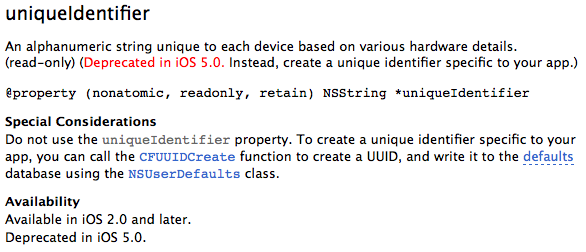
They use a property called “uniqueIdentifier”.

Apple is now deprecating the method that is used to access the UDID of a device from within the app.

In other words, this method is slated for removal in some time and the apps already using this need to make provisions to transition off it.

Here’s what they say in the documentation.

uniqueIdentifier

Now how does Apple’s decision affect the stakeholders.

As for end users, it doesn’t affect them at all.

They have remained oblivious to the presence of UDID and would continue to do so.

There have been some blog posts around users screaming that their privacy is being compromised just because the app is sharing their UDIDs.

Baah! I dont see why that should be a big privacy concern.

There is a significant change for developers / app providers and advertisers however.

Some applications needed to identify individual users, say for subscription purposes.

Either they required all users to have an account at a central location, or they had to identify the user remotely on his device.

UDID helped in the latter scenario.

Using UDID and a little analytics code, the app provider could get valuable insights into the usage of the app.

However, with UDID going away, each app would have to create its own identifier for each device.

While that alone would not be a problem, the issue would be in reconciling this data with the previous data that used other means of identifying a user (UDID or a hash based on it).

So unless the app developers can find out a cunning way to reconcile the data, they would be starting afresh essentially.

Because this analytics data was the advertisers’ holy grail, they have nothing to cheer about either.

But why is Apple doing this anyways?

Well, “Who is John Galt”?

[I am reading Atlas Shrugged by Ayn Rand of late and this phrase stuck.]

Some highlight privacy concerns, including law suits, raised by some users of late (which I find frivolous).

However, there might be a hidden agenda of Apple in seeking to discontinue use of UDID.

Apple gets a share of the revenue generated by selling paid apps on its store.

It also gains from paid subscriptions.

Normally, when you buy a paid app, you can download it on another device at no extra cost by signing in with the same Apple id.

Apple gains on the first purchase, but subsequent installs don’t add to its coffers.

However, there are some paid apps that charge you for every install.

So if you paid a dollar when you bought and installed the app on your iPhone, you might have to pay some more to install the app on a new device, say your iPad.

This model is made possible only by identifying the devices individually and not necessarily the user alone.

Doing away with UDID would do away with this model too.

Could that be the reason?

Well, we would see.

Enough of doom and gloom.

There’s still a way out.

If you don’t really require any feature offered by iOS 5 SDK, you can continue to use any lower version and still access a device’s UDID.

The access is going to be deprecated only for iOS 5 SDK.

So unless you want to use iOS 5 SDK, you are good.

So long.

Does Agile Manifesto Need Changes? The 10 Years Experience!

AgileManifesto10

I delivered a presentation on the above topic earlier this year at an Agile Conference in NCR, India.

I have summed up my thoughts below.

On a cold winter morning of 13 Feb 2001, at a ski resort in Utah, the Agile Manifesto was born.

The newborn had 17 fathers (ahem ahem), all stalwarts of the software industry, trying to be Agile in their own way, ahead of their times.

Though some leading software practitioners were following some form of Agile (without calling it that), the real precipitation of thoughts happened in February 2001.

And thus emerged the Agile methodology of software development as we have come to know it.

In 2011, while the whole Agile community was united in celebration of 10 years of Agile, there were a lot of Agile practitioners who felt the need for a change – maybe a change from Agile to another methodology (like Agile was to Waterfall), or changes in the basic foundation of Agile (the Agile Manifesto and its 12 core principles).

This whole dissonance stemmed from not achieving the kind of success we had hoped for.

Their concerns did resonate with me but when I dug a little deeper, I realised that difference between our results and expectations arose from the way Agile was implemented, the way it was morphed into something else, a commonly known phenomena as “Agile-but”. (You might have hears people saying, “we do Agile but….instead of X we do Y”).

It is completely okay to let Agile fit your organisation as it is not a set of commandments one ought to follow. But there is a “spirit” that is embodied in the Manifesto and the principles which should never be compromised.

I agree that it is really tough to explain that spirit in words but you would get a sense of it once you start “living” Agile, not just following it, or doing it, or practicing it.

(God, I am sounding like Yoda instructing Luke Skywalker: You must feel the Force around you. Here, between you, me, the tree, the rock… everywhere!”)

While I was preparing for this presentation, I came across a wonderful tongue-in-cheek take on Agile.

We have heard about new ways of developing software bypaying consultants and reading Gartner reports. Through
this we have been told to value:

Individuals and interactions over processes and tools
and we have mandatory processes and tools to control how those
individuals (we prefer the term ‘resources’) interact

Working software over comprehensive documentation
as long as that software is comprehensively documented

Customer collaboration over contract negotiation
within the boundaries of strict contracts, of course, and subject to rigorous change control

Responding to change over following a plan
provided a detailed plan is in place to respond to the change, and it is followed precisely

That is, while the items on the left sound nice
in theory, we’re an enterprise company, and there’s
no way we’re letting go of the items on the right.

The above conveys my sentiments on the current state of “Agile” well.

And let me not stop there.

I have come across enough real-life examples to illustrate this.

These examples are from companies / projects based on Agile methodology.

I have mentioned them under the statement that they seem to violate

Individuals And Interactions Over Processes And Tools

  1. “This part was not implemented because it was not written in the user story. So what if it was discussed.”
  2. “Please create a ticket/story for whatever you want to be done”
  3. QA/Tester: “Wait. Don’t fix the issue now. Let me first create a ticket on it”

Working Software Over Comprehensive Documentation

1. “We are Agile. We don’t document”
  2. “User stories need to include even the last bit of detail”
  3. After a sequence of changes over time with a functionality, “Make sure you reflect the changes in the stories”

Customer Collaboration Over Contract Negotiation

  1. “Lets write detailed user stories about the features that would go into the project so that the customer/developer is bound by them”…(later)…“Hey, that was not in the scope”

Responding To Change Over Following A Plan

1. “We are Agile. We don’t plan”…(LOL)
  2. “We never discussed this feature”
  3. “I don’t care if your system crashed, I want this functionality delivered by weekend”

I would like to share a quote that, I believe, truly represents that spirit of being Agile

Float like a butterfly,
sting like a bee
– Boxing Legend Muhammad Ali.

Wrapping this up, saying that Agile needs change when we were not able to implement it properly is akin to saying that one has wrong feet when he is wearing shoes wrongly.

What’s New in iOS 5

IOS5 Image


This is the first major upgrade to iOS ever since it was rechristened from iPhone OS.

Apple’s iOS 5 page says that they are “taking iOS to a whole new level”.

Scott Forstall, SVP iOS Software, says that this is the “widest and most extensive update for iOS, ever”.

The update boasts of 200 new updates.

Let’s look at the new features to see if that is really true or is it just old wine in a new bottle.

I am able to review some of these on an iPad running iOS 5 Beta 7.

1. Notifications

This is not a new feature. iOS users are already familiar with notification pop-ups and badged icons. What is new is the way these notifications are lending themselves to the user.

With the device in an unlocked state, you can drag down the notification bar on top and see a list of notifications from various apps. Tapping any would take you straight to that app.

While iOS users may drop their jaw on this, Android users are only yawning as this was already on Android since version 1 !!! (do I hear someone shouting “copy-cats”)

Additionally, the iOS notification drop-down also shows weather and a stock ticker.

Even in a locked state when the device shows a list of notifications, you can swipe a notification directly and open its app instead of having to unlock the device first. Now that is something that would make Android users jealous.

2. Newsstand

Apple had caused a lot of heartburn to publishers earlier this year over its seemingly atrocious terms of engagement.

However, after the two parties agreed to mutually respectable terms, it was the end user who emerged as a winner.

Newsstand is a single repository of all your newspaper and magazine subscriptions purchased from App Store.

The magazines and dailies are downloaded in the background and are available for offline reading.

Simulating your book shelf, the exploded view of the newsstand shows you the cover of each magazine and daily that you have subscribed to.

3. Twitter

Twitter app for Apple was already available since but what is new is the OS wide support for it.

Integrating Twitter into iOS and offering it as a single sign-on is a smart move by Apple and great news for the Twitterati.

Now you can sign-on with Twitter and login to any other application permitting a Twitter login without having to specify your credentials again.

Not to mention, that the OS wide integration allows you to Tweet from a lot of native applications like Photos, YouTube, Safari, Maps, etc.

Additionally, you can complement your contacts information with their Twitter information like photo, @username, etc.

4. Safari

Mozilla’s Firefox has always been my personal favourite (at least on a PC*) but the additions iOS has done to Safari really tempt me to switch.

When you are reading an article (blog post, news article, etc.) on Safari and switch on the Reader mode from the address bar, you see the article freed of all the clutter (like side bars, ads, related stories, all the junk that web developers like us put in a page). The article is displayed in a neat (I am tempted to say “sexy”) fashion with Serif fonts, a la hardcopy publication. Just focus on the article without any distractions.

Reading list is another interesting addition. It allows you to save articles for later viewing. And more importantly, this list is accessible across devices by using iCloud. So you can view articles on your iPhone while commuting home that you had saved earlier on iPad while in office.

And to top the Safari cake is the cherry of tabbed browsing. Switch among multiple tabs the same way you would on your PC*.

5. Reminders

I have always had trouble managing my to-do lists, at least on a PC. Simple text document, Excel sheet, Ta-da lists, I have tried it all.

But this simple application can be a solution to all your woes about managing to-do lists, at least on iOS.

You can create new lists and quickly add list items. Check them off as you complete them.

View all completed list items in a separate list and in the list you created.

You can mark a date and time to be reminded about an individual list item (without which it would not make sense to call the feature as “Reminders”).

Here comes the best part about reminders: in addition to specifying time and date, you can also specify place. That is, be reminded of a chore when you arrive at a place (pick up groceries from supermarket) or when you leave a place (call your wife when you leave from office so that she can be prepared with a new set of chores when you reach home).

And you can sync these reminder with your other Apple devices using CalDAV or iCloud or with your Outlook using Microsoft Exchange.

6. Camera

Now Apple claims to have the most popular camera among mobile phones and as popular has regular cameras using Flickr as a reference for this statistic.

Even if that were to be true, the new features would only serve to bolster iPhone’s camera’s position.

The chances of missing a moment worth capturing are even less with the quick access to camera even from the lock screen.

Just double click the home button to reveal the camera button and dive straight into the camera app.

And click like a regular camera with your iPhone held in landscape mode and using the volume-up button. 🙂

Also you can view grid lines on your screen so that you can align the picture even before taking it.

Want to zoom in, just pinch to zoom!

Another great feature which I doubt if any other mobile camera has is an AE/AF Lock.

Now I am not a photography expert but as I understand, on iPhone, if you select an area and lock the AE/AF (auto exposure, auto focus) and even pan a little, the exposure and focus of the selected area would not change despite the change in background light.

I would have to check this on an iPhone running iOS 5 but as I gather from Scott’s# demo, it seems to work.

7. Photos

All that beautiful pictures can me made too look even better by some handy tools now offered by the Photos app.

I hate it when my eyes in the photo appear red as if I am a Sith lord. You need not make your loved ones look like that if you use the red-eye reduction tool.

Then you can also crop, rotate, organise into albums the photos you took on your iPhone on the phone itself.

8. Mail

While the mail app on iOS devices used to appear like makeshift mail, it is going to become lot better and would come close to appearing like the mail on Mac (well, almost).

With the addition of rich text editing (bold, italics, underlines, etc.) and indentation, mails sent from iOS devices would look lot more like their Mac cousins.

Besides, you wont have to type again if you mentioned a contact name by mistake in CC instead of To or BCC. Just drag them to the other field.

Messages can be flagged / unflagged on the device itself, searching would include the mail body in addition to the to, from, and subject fields, swipe to view/hide the inbox, yada yada yada.

But one feature really made me skip a beat (I actually said “Whoa!” when I saw the demo) is the split keyboard on iPad

You can split the keyboard and drag it upwards so as to type by just using your thumbs while holding the iPad. Awesome!

9. PC Free

This is actually a goood one (that wasn’t a typo, I use the ooo sound when I really like something, like “hey, that girl is goood”)

The pre-requisite of having a PC to sync your device with has been done away with.

The iOS device can be the only computing device in your home for all you care.

Activate, update it over-the-air. Not to mention that updates are now delta-updates so you just download what has changed, not everything including the kitchen sink.

10. iMessage

Well, I am not saying that Apple is trying to emulate the success that BlackBerry achieved through its BlackBerry Messenger, but…umm…yes, I think I am saying that.

But its a great feature to have anyhow.

iMessage allows you to exchange messages over 3G/Wi-fi with your friend if he/she also has an iOS device.

iMessage is built into the existing messages and allows you to exchange photos, videos, group messages, and of course simple texts.

You can receive delivery receipts (no more excuses like “I never received your message”), read receipts (or “I didnt read your message”) and even get to know when the other party is typing a message.

Besides, these messages are synced across all your iOD devices so you can resume the conversation from your iPad if, for example, your iPhone got run over by  a truck.

11. Wifi-Sync

This is another feature that aims at making your iOS device truly wireless.

No need to plug in your device to your PC to sync with iTunes. A shared wi-fi connection between your device and the PC would handle the syncing.

But, I am wondering what would be left of the poor battery if you are syncing a lot of audio and video.

These were some of the new features that iOS offers to the end users.

But even iOS developers have a lot to cheer about.

With more than 1500 new APIs, developers can unleash their creativity and develop really useful apps (and some weird ones too).

Apple claims to have done significant enhancements to Xcode, Instruments, and Simulator.

Then they have incorporated the CoreImage framework from Mac OSX to iOS that allows the developer to weave some real magic in their apps that handle images (red-eye reduction for example).

Hope you enjoyed reading the blog.

Stay tuned for more.

Feel free to comment on this post.

* The term PC has been used to differentiate desktop computers, laptops from mobile iOS devices.
# iOS5 introduced and demoed by Scott Forstall, SVP iOS Software

References

1. Keynote Video
2. iOS Video
3. Features
4. Title Image Source

From Tumblr to WordPress

Tumblr-Wordpress

Even though WordPress is almost the default choice when one thinks of blogging, I chose Tumblr to launch my blog.

Partly because of the hype it was generating and partly because of the customisation it lent.

I was fortunate to generate lot of traction with my blog soon after launch – tweets, reblogs, share, etc.

However, I realised that I was not able to access details of the above which other Tumblr blog owners could.

Oh that horrible day when I created a ticket on this for Tumblr.

Soon after, my blog went offline for days altogether.

When it finally came up after continuous pleading to Tumblr guys, I noticed that all the data on sharing etc was lost!

I again approached their tech / customer support but in vain.

After a month, I finally gave up.

I have now realised that while Tumblr might be a great platform when it comes to functionality, it is terrible from a support perspective.

After a few months of launching my blog, I am finally relaunching it on WordPress.

Looking for the same love and respect that you guys showed me earlier.

So long.

Hello World!

Hello_World

“Not another blog”, I hear you saying.

When everybody and his brother has a blog, why should I be left behind. 🙂

Jokes apart, my motive behind this blog is not to air my high-headed opinion about everything or be a self-styled critic.

Through this blog, I intend to marry my love for technology (digital / analogue, software / hardware) with my recent OCD to write.

I keep running into tech that, I believe, needs to be talked about, for good or for bad reasons.

This blog would channel that need.

Then, there are some aspects of this world that might not have a direct relation to technology but could not have existed had this world not been technologified (whoa, did I just create a new word).

I would try and do justice to those aspects as well.

And I must mention that this blog has no connection, not even remotely, to any organisation or company by the same name.

As for me, I am a ScrumMaster working as a Project Manager with a tech company based out of New Delhi, India.

I have spent the better part of my life tinkering all kinds of things from circuit boards to bike engines to software.

So stay tuned in for good (or maybe terrible, depending on your taste) stuff.